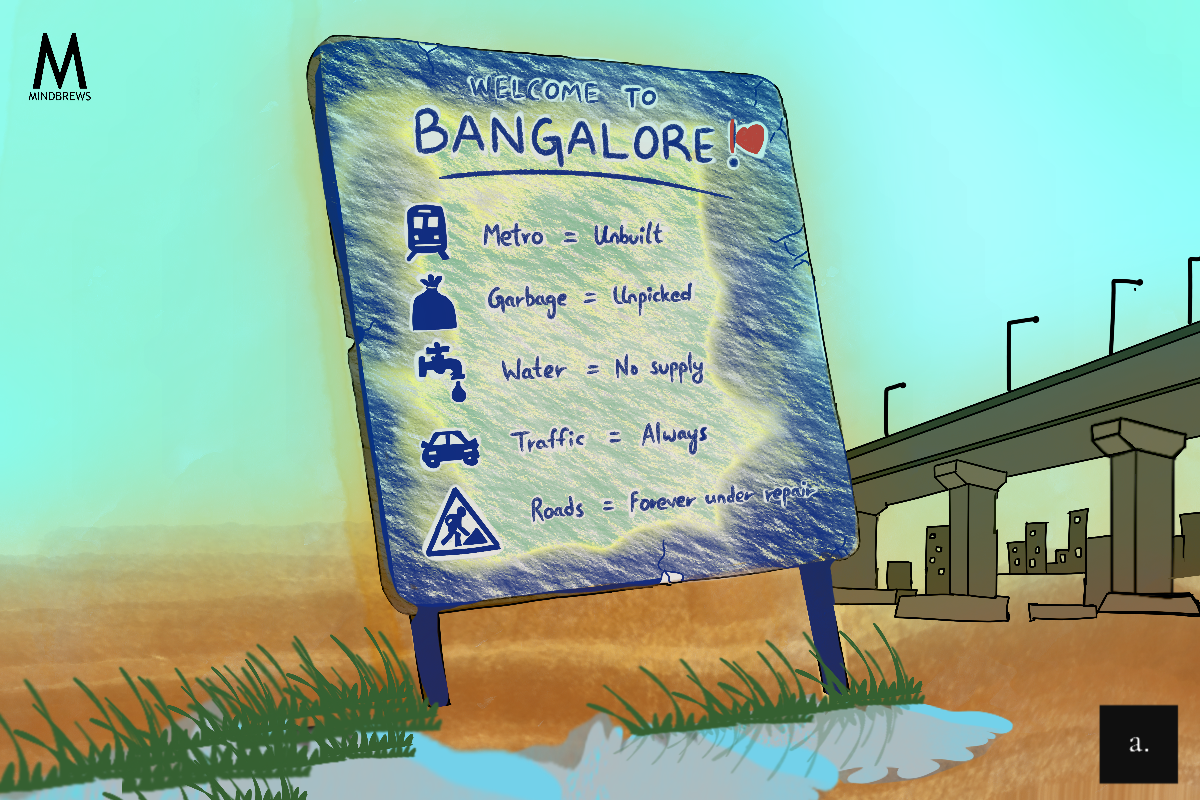
This fictional story follows a lifelong Bangalore resident as she watches the city she loves change around her. Through traffic, construction, polluted lakes, dry borewells, unfinished roads, water insecurity and unequal public services, it explores the gap between Bangalore’s image as India’s technology capital and the experience of living there.
Hello, I’m Kavya
I’ve lived in Bangalore all my life.
I’ve travelled a bit.
Different cities. A few countries.
But I have always chosen to stay here.
The only place where I have ever truly felt at home.
This city used to give me a lot of hope.
On good days, it still does.
They call it the Silicon Valley of India.
Or better yet—
the Garden City.
The most progressive city in India?
That’s what they all said.
Living here used to be fun.
For many, it was a real aspiration.
Now, some days, leaving the house
feels like absolute desperation.
Excess traffic?
Check.
Dust everywhere?
Affirmative.
Roads dug up with no explanation?
Indeed.
Road repaired suddenly?
Oh, yes.
Road dug up again?
Well, wouldn’t you want to know?
The next Namma Metro line?
Don’t worry.
It’s coming soon.
They said that a decade ago.
They say it’s us.
That we’re going crazy.
That we’re criticising the country.
Being unpatriotic.
But we know it’s not us.
It’s what living in the city has started to feel like.
It’s standing in a queue for water
that still doesn’t arrive.
It’s watching CMH Road get dug up.
Again.
It’s watching Electronic City traffic
turn an ordinary journey into a daily negotiation.
It’s looking at Cubbon Park
and wondering how much more green
this city can afford to lose.
It’s watching Bellandur Lake
choke on sewage and pollution.
It’s watching Koramangala flood
after another heavy rain.
It’s watching one more tree disappear
from Jayanagar.
And it’s watching the Garden City
become a map of unfinished infrastructure.
Sometimes, walking two kilometres
feels like an obstacle course
through everything that is broken.
—
In the summer of 2024,
thousands of the city’s borewells went dry.
Not in some distant village.
Here.
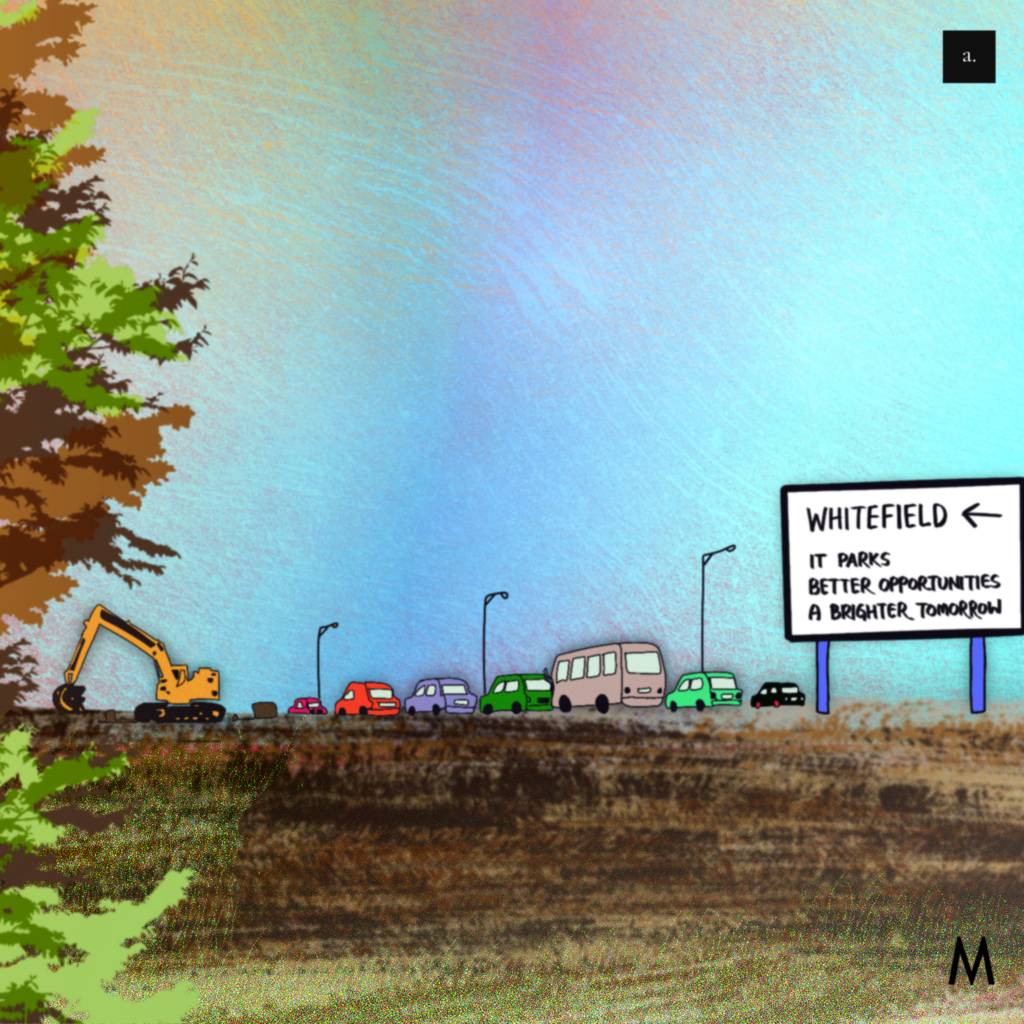
Whitefield.
Bellandur.
This road.
Then the Silicon Valley of India
stood in line for a tanker
and paid whatever the tanker asked.
—
And then there is a government school
down the road from here.

Two hundred and thirty-six children.
Up from a hundred and sixty last year.
Two permanent government teachers.
The rest?
An NGO had to arrange.
On the day of the visit:
No soap.
No fire extinguisher.
No dining hall—
the children eat in the passage.
The girls’ toilet was locked
when we arrived.
And in computer class,
they are learning HTML, CSS, JavaScript and AI.
Down the road from the offices
that gave this city its name.
Yet nothing really feels the same.
Because this school is not a side story to Bangalore’s collapse. It is the clearest version of it.
A city can call itself progressive, global and smart. But when a public school inside its technology corridor has two permanent teachers, no dining hall and a locked girls’ toilet, progress starts to sound less like a fact and more like branding.

But it’s not just me saying this.
I have a friend who does this thing –
every year, he goes and lives on a farm
for a few weeks.
Maharashtra.
The same villages.
For years now.
He called me after his last trip.
Said something had changed.
And what he described stayed with me. Because while Bangalore – the city that sells the future – was struggling to deliver water, roads and teachers, something was changing in places we are taught to think of as left behind.
I’ll let him tell his story, next time.